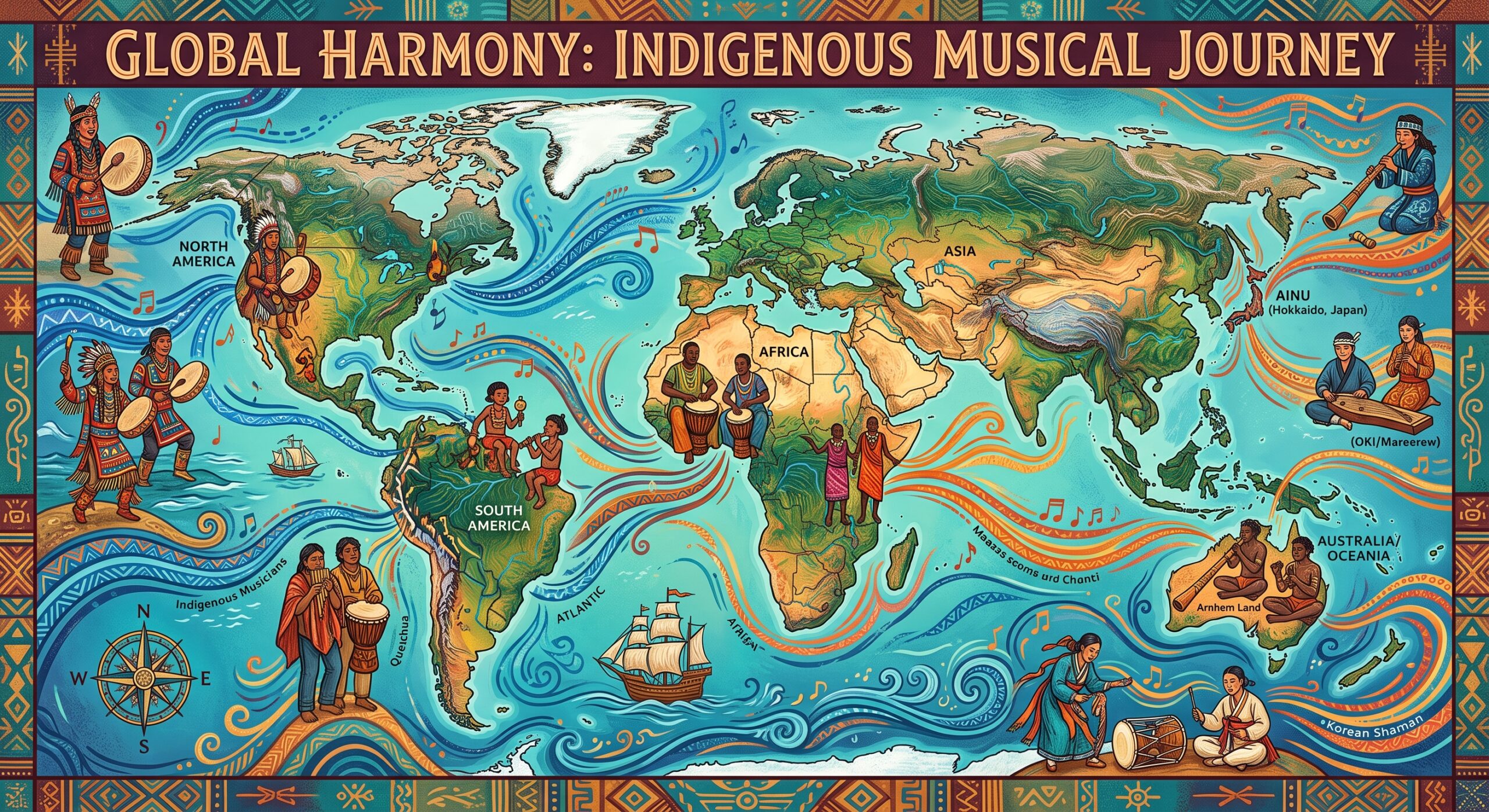
Photo and Illustration Credit: Ed(Ahmed) Walwail
Music did not begin in quantized digital audio workstations or polished commercial recording booths. It began as an organic extension of breath, environment, and communal ritual. From the polyphonic Upopo vocal rounds of the Ainu in Hokkaido and the termite-hollowed Yidaki drones of Arnhem Land, to the buzzing reed resonance of the Basque Alboka and the cyclical Maracá pulses of the Amazon, ancient music is living oral history.
For decades, modern music production struggled to translate these deeply root-bound acoustic traditions without flattening their character into generic world-music presets. Today, a new paradigm of musical arrangement and acoustic modeling—developed by Ed Walwail at Labmations—bridges this gap: taking foundational, simple musical motifs and translating them into the authentic instrumental and vocal languages of global Indigenous cultures
The Evolution: Beyond Generic Digital Emulation
Conventional production often treats world instruments as superficial plug-in presets applied on top of a standard Western 4/4 pop grid. This approach strips Indigenous music of its defining qualities:
1. Acoustic Ecology: Traditional instruments are made of the local geography—reindeer hide, volcanic rock, hollow eucalyptus, animal horn, and river cane. Their timbre carries the acoustics of their landscape.
2. Microtonal Freedom: Indigenous melodies often exist outside the equal temperament scale, relying on microtonal inflections, vocal glides, and open harmonics.
3. Collective, Cyclical Structure: Rather than relying on rigid verse-chorus formulas, ancient music is driven by trance-like cycles, interlocking canons, and responsive group singing.
The system developed at Labmations re-engineers musical ideas by structuring them around the physicality and spiritual intent of each tradition. Instead of imposing a rigid digital rhythm, the framework lets the instruments dictate the time feel, phrasing, and tonal texture.